A service is commonly defined as a means to deliver value to customers by facilitating outcomes which customers want to achieve without the ownership of specific costs and risks.
What is Service Management
Service Management is a set of specialized capabilities for providing value to customers in the form of service. It provides a holistic approach where all the Information Technology Infrastructure Library (ITIL) processes are interconnected to form a seamless, effective, and efficient service. This moves us away from organizational based silos and supports the company value of customer orientation.
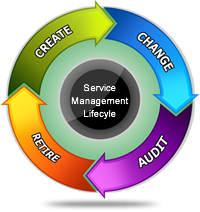
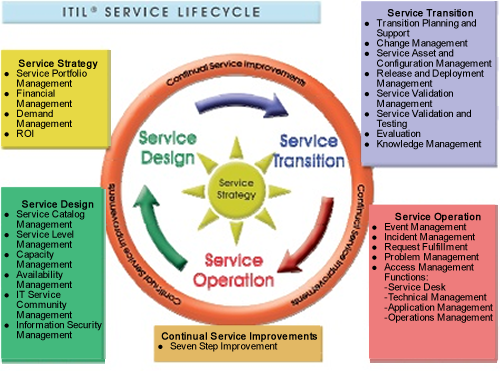
Additionally, Service Management is concerned with more than just delivering services. Each service, process or infrastructure component has a lifecycle, and service management considers the entire lifecycle from strategy through design and transition to operation and continual improvement.
How Service Management delivers & manages the services
Service Management provides the framework and processes that
Enables the service provider to understand the services they are providing.
Ensures that the services facilitate the outcomes their customers want to achieve.
Increases understanding the value of the services to customers.
Improves comprehension and management of the costs & risks associated with the services.
Service Management ensures that service providers business goals are met, and that value is delivered by providing both the business and IT with a common set of best practices and tools. There are service management goals common to the Information Technology Infrastructure Library (ITIL) framework, and there are company specific service management goals.
Effectively deliver and support IT services at the correct level to meet business requirements
Provide information & interfaces between suppliers-departments-customers
Align IT internal operational (production) services with current & future business needs and customers
Improve the quality of IT internal operational services
Reduce the long-term cost of service delivery
Note: ITIL is an acronym for Information Technology Infrastructure Library (ITIL) and is made up of a collection of best practices found across the range of IT service providers. It offers a systematic approach to the delivery of quality IT services.
A service is commonly defined as a means to deliver value to customers by facilitating outcomes which customers want to achieve without the ownership of specific costs and risks.
What is Service Management
Service Management is a set of specialized capabilities for providing value to customers in the form of service. It provides a holistic approach where all the Information Technology Infrastructure Library (ITIL) processes are interconnected to form a seamless, effective, and efficient service. This moves us away from organizational based silos and supports the company value of customer orientation.
Additionally, Service Management is concerned with more than just delivering services. Each service, process or infrastructure component has a lifecycle, and service management considers the entire lifecycle from strategy through design and transition to operation and continual improvement.
How Service Management delivers & manages the services
Service Management provides the framework and processes that
Enables the service provider to understand the services they are providing.
Ensures that the services facilitate the outcomes their customers want to achieve.
Increases understanding the value of the services to customers.
Improves comprehension and management of the costs & risks associated with the services.
Service Management ensures that service providers business goals are met, and that value is delivered by providing both the business and IT with a common set of best practices and tools. There are service management goals common to the Information Technology Infrastructure Library (ITIL) framework, and there are company specific service management goals.
Effectively deliver and support IT services at the correct level to meet business requirements
Provide information & interfaces between suppliers-departments-customers
Align IT internal operational (production) services with current & future business needs and customers
Improve the quality of IT internal operational services
Reduce the long-term cost of service delivery
Note: ITIL is an acronym for Information Technology Infrastructure Library (ITIL) and is made up of a collection of best practices found across the range of IT service providers. It offers a systematic approach to the delivery of quality IT services.
Service Transformation is used to effectively deliver Service Management by aligning closely with IT’s vision and service strategy. Transoformation aligns IT's resources through shared business practices, a common set of processes and tools, and a strategic focus on service objectives and core service functions of organizations within IT. This ensures recognized and measurable value.
Why Service Transformation
A well-operating Service Management model enables us to view information about our customers more holistically, which increases resource & operational efficiency. This provides a "whole picture" view of the end-to-end stack of components which are required to deliver that service to the customer.
With this foundational transformation of IT Services, we’re going to Measure, Monitor and Manage our services end-to-end.
Transforming the way we do business
Service transformation considers how business is done today, anticipates how it will be done tomorrow, and the transformation piece is in the middle which requires understanding.
To deliver end-to-end service expectations for our customers, we need a foundation of Operational Discipline. Operational Discipline refers to the core values and common behaviors that guide our actions and decisions to deliver reliable, robust, and efficient services.
These behaviors include fundamental items such as:
setting clear goals & measuring performance,
driving continuous improvement in everything we do,
developing our skills, and
capturing what we learn and sharing that learning across our entire organization.
Service excellence allows us to look at the end-to-end lifecycle of services and enables operational discipline to manage them. This improves indicators and supports an environment where the people have correct roles, responsibilities, and accountability.
To achieve excellence, it is important to align our organization with a single vision and a clear set of performance expectations to achieve that vision. Delivering IT services needs to be globally consistent.
Key to Service Excellence
1. Service Governance “Service is the culture"
Provide vision & direction for the IT Services Catalog. Service & process ownership have distinct roles & decision rights.
2. Resources (What) “Process trumps org”
Align people and technology assets to the IT Services Catalog.
3. Process Tools (How) “Lead with process, follow with automation”
Drive continuous process improvements via integrated toolset/instrumentation.
Service Management Structure
IT delivers over 90 different services globally. Each service will follow a standard set of Service Management processes and goals identified in the Service Management lifecycle.
With such a large global scope, the delivery of IT Services has to be globally consistent and delivered the same way for our customers. After all Services go to the Service Transformation, they will be executing the delivery of their services in a similar manner.
Copy Exact Service Management Process
Each service executes the same service management processes. For instance, the Incident Management process is defined, has a workflow, and has people who fill roles supporting the process. The process is structured and executed by all services in the same way. Every IT Service shares those processes as defined in the IT Service Management lifecycle.
Benefits of Sharing Common Processes
Quick ability to store and report information with increased efficiency for remedying issues
Consistent inputs across the services results in better data mining (improved trouble shooting, increased consistency & reporting)
Facilitates mapping the end-to-end process details down to the infrastructure
Ability to look at assets (hardware, software, people) and allow IT to determine the true cost of delivering and supporting the service
The company's Information Technology group (IT) partners with other company business groups to deliver solutions and services that help drive company-wide efficiency and productivity, keeping the business running.
Who is supported by IT and IT Services?
Over 100,000 company employees in 150 different sites supporting 90+ IT services.
The Information Technology group partners with company business groups to deliver solutions and services that help drive company-wide efficiency and productivity. This supports keeping the business running.
Service Management processes are tied together and never stand alone. Each process is a cog turning in concert, synergistically with other process cogs to ensure successful service delivery. Our success maintains minimal (or none) service interruptions while anticipating events to plan and mitigate issues before they occur.
Process
Goal
Knowledge Management
Provides information to support Incident Management and customer self help.
Incident management
Resolve the customers service issue as quickly as possible.
Service Request Management
Fulfills requests for new services.
Event Management
Monitors service components to quickly detect & resolve service issues.
Problem Management
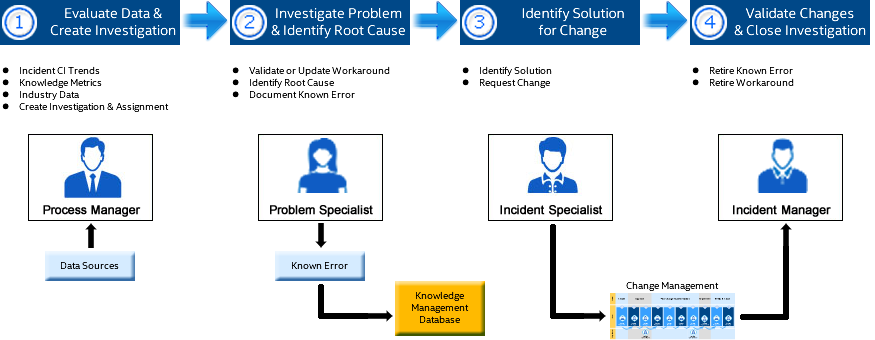
Investigates service issues to understand root cause. Provides workarounds and proposed corrections.
Change Management
Implements changes to improve service.
Asset & Config Management
Provides information about the service components in the environment.
Click to view a demonstration on ITSM Process Interactions.
Within IT Service Management Transformation, each service reports out using common KPIs, which enables IT to measure the same standards across all services. A service can choose to measure service specific KPIs or metrics. KPIs plus service specific metrics are represented on the service dashboard.
The below graph shows how the Processes & Services intersect and provide reporting results.
Follow the processes from left to right across each service. This results in common Key Performance Index's in process dashboards. This structure enables IT to measure the same data across all services.
Follow the services from top down. This produces both KPI's & Service Specific Metric's for the service dashboards. It also provides a holistic view of the overall IT Services.
Essential Elements of a Service
Every service is unique in the value and components provided to company employees. The service management framework gives the service owner the support methodology to ensure that the service items have the proper support skills embedded. All services are structured in a common manner with key similarities:
All IT services are defined with a name for the service, such as Messaging.
Each Service is made up of one or more sub-service component that is related to the delivery of the service. Each service component has one or more support skills.
Each support skill aligns with a process role that ties directly to the individual ITSM process. This provides complete, end-to-end service delivery.
Roles in Support of the Service
Each person is assigned one or more roles in the IT Service Management platform.
Your service, service component, and support skill in combination with your process role determines if you have the ability to have that ticket or record assigned to you.
A role in relation to the delivery of a service is an individual set of standardized responsibilities that support a particular process within an IT Service.
Part of the service structure identifies roles supporting the Service Management process. Everyone who supports a service will have a role associated to him/her. Almost every process has a process manager such as incident manager, change manager, etc., and a specialist such as problem specialist or an incident specialist role associated with it.
The below diagram illustrates the hierarchy of various roles in the service structure.
Roles Alignment within a Service
Each service has the same set of roles in relation to the process that supports the service. For example, look at Incident Management and note that there are Incident Managers, Escalation Managers, and Incident Specialists (Levels 1-4) associated. This is the same structure for every single service using Incident Management that comes into the system. Each ITSM process is organized in the same fashion.
Service Management - Key Management Roles are involved in the Service Management lifecycle. Looking at a high level view of the role hierarchy, notice that each service has a Service Portfolio Manager and Service Owner with additional roles supporting the Service Management processes.
Each process has a Process Owner and a Process Analyst who works with the Service Owner.
Service Owner Role
End-to-end Service Management requires several essential elements for the success of the service. One essential element is a Service Owner.
Every service has a Service owner who is accountable for the end-to-end performance and success of the service.
Service Owners are responsible for the performance of their service and will make decisions regarding their service.
Service structure is often different than an organization structure. Employees do much of their work in support of the service. Based on the role, employee's are responsible for specific tasks within a service or multiple services. The manager and organization may, or may not, always be part of the service structure.
Recognize that various employees may belong to certain business organizations, but those organizations do not affect or influence the service structure an employee contributes value. In many cases, a particular organization Manager and the organization itself may not be a part of the service structure. There may be no tie between the service structure hierarchy and an organization hierarchy.
It is important to remember that people provide a role in support of a service. It does not matter what organization they sit in or from what group in IT they are from. Service structure is often different than organization structure, and all people do needed work in support of the service.
Changing Perspective
Talking about the delivery of a service is not the same as talking about an organization. This is a new concept that requires a transformation of thought. IT has functioned within organizational silos and supporting products structure, so a transformation of thought reveals a different structure to the way we typically do business.
By adopting a service perspective with a focus on the Customer Orientation, it allows us to provide service-based performance measures and financial views. The service perspective highlights a single customer level agreement, and the standardization and integration of tools, processes, and roles.
Role your cursor over each service perspective title for further information.
Service Management AdvantagesThe service perspective impacts our business with ...
Improved interaction with users.
Integrated knowledge base for quicker call resolution.
Improved incident tool performance.
Continuous visibility of service component information.
Improved data analysis for Problem Management through a simplified incident category system.
Better data for making investment decisions
When you have completed the learning for IT Service Management Overview, click the below Track Completion button.
This allows the IT Service Management team to know that you have completed this learning and are prepared for relevant next steps.